

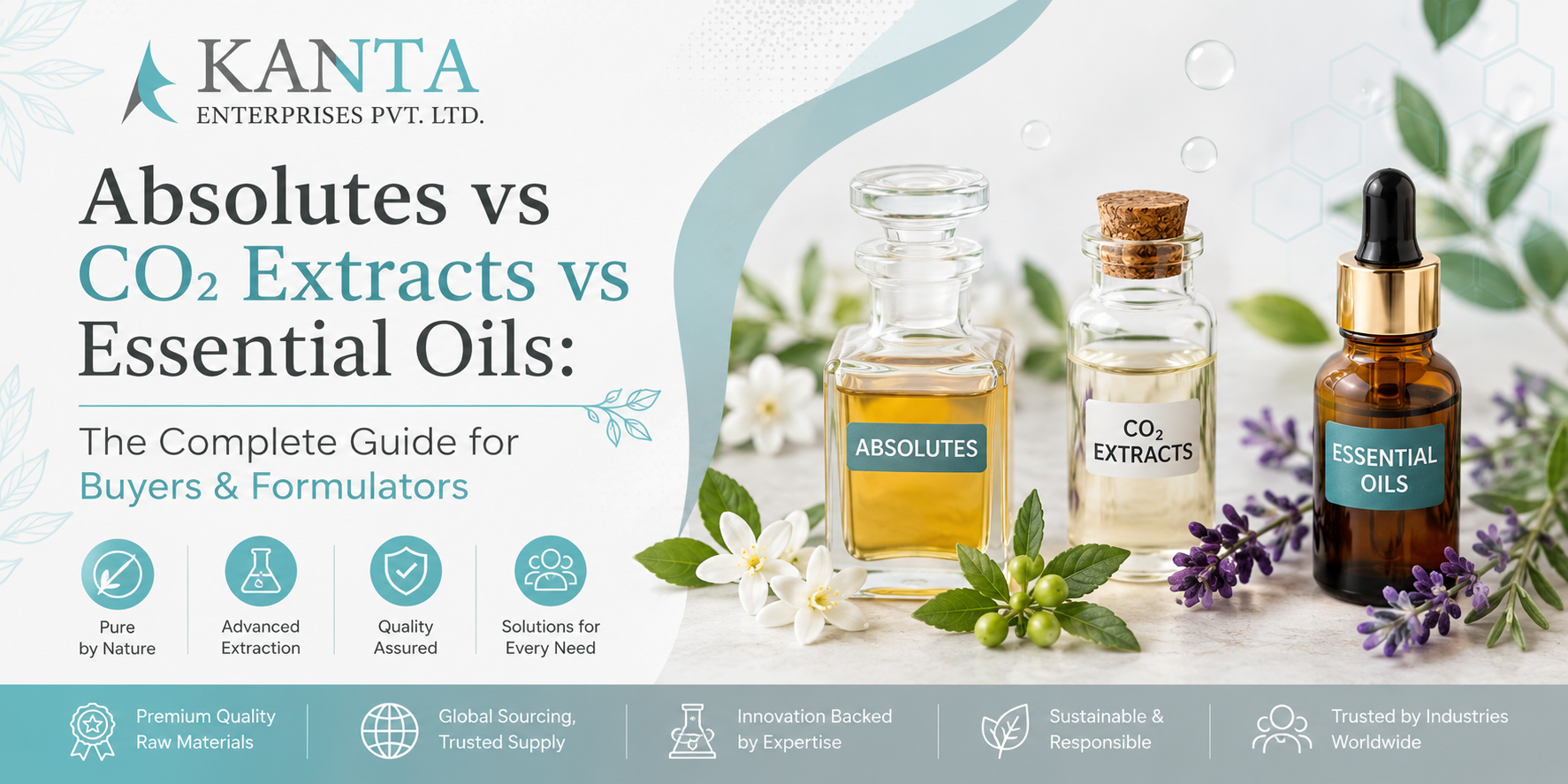
If you work in perfumery, cosmetics, aromatherapy, or natural flavors, you’ve almost certainly run into this confusion: absolutes, CO2 extracts, and essential oils get marketed like they’re interchangeable.
They’re not. Each one is pulled from the same raw plant material using a completely different extraction process, and that single difference changes the aroma, the chemistry, the cost, and what the ingredient is actually good for.
Get this choice wrong, and you’re not just wasting money. You’re formulating with the wrong raw material entirely, which can throw off your fragrance profile, your product’s shelf life, or your compliance with clean-label and IFRA standards.
This guide breaks the three down properly, so you understand exactly what you’re buying, why it costs what it costs, and which one your product actually needs.
Why This Distinction Actually Matters
Before getting into definitions, it helps to understand why this matters beyond theory. Every extraction method captures a different slice of a plant’s aromatic chemistry:
Steam distillation only captures the lighter, volatile molecules that are able to travel with steam vapor. Solvent extraction captures waxes, pigments, and heavier aromatic compounds that steam physically cannot reach. CO2 extraction captures almost the entire aromatic spectrum of the plant, gently and without any heat damage.
This means the same raw material, say rose, ginger, or vetiver, can produce three genuinely different ingredients depending on which method is used. If your formulation depends on a specific scent depth, a therapeutic property, or a clean-label claim, picking the right extract isn’t a minor technical detail. It’s the foundation the entire product is built on.
What Are Essential Oils?
Essential oils are extracted through steam distillation, or cold pressing in the case of citrus peels like lemon, orange, and bergamot. In steam distillation, steam is passed through plant material such as flowers, leaves, bark, roots, or seeds.
The heat causes tiny aromatic compounds trapped inside plant cells to release and travel along with the vapor. This vapor is then cooled and condensed back into liquid form, where the oil naturally separates from the water. The leftover water, incidentally, is what becomes floral hydrosol.
This is by far the most common and cost-effective extraction method in the industry, which is why essential oils dominate aromatherapy, personal care, soap-making, candle and diffuser fragrance, and natural flavoring applications. They are highly concentrated, reasonably consistent from batch to batch, and priced in a way that supports large-scale manufacturing.
The trade-off is that distillation involves heat and pressure, which can degrade or completely destroy some of the more delicate aromatic molecules. This is exactly why flowers like jasmine, tuberose, and rose petals are rarely distilled. The process would strip away the very qualities that make them valuable in the first place.
What Are Absolutes?
Absolutes exist to solve the exact problem essential oils cannot handle: extracting true scent from delicate flowers without destroying them in the process. Instead of steam, absolutes rely on solvent extraction.
The plant material is washed repeatedly with a solvent, typically hexane, which pulls out the waxes, pigments, and aromatic compounds together, forming a waxy, semi-solid substance called concrete. This concrete is then washed again with ethanol, which separates the true aromatic compounds from the waxy residue. The alcohol is later evaporated off, leaving behind the concentrated absolute.
The result is a scent remarkably close to the living flower itself, deep, rounded, and far more complex than anything distillation could achieve. This is exactly why absolutes such as jasmine, rose, tuberose, mimosa, and violet leaf are considered essential building blocks in fine and luxury perfumery, where authenticity and depth of scent matter more than cost.
The trade-off is that absolutes typically retain trace solvent residue, so they are generally used in fragrance applications rather than direct-to-skin products. They also command a higher price due to low extraction yields and a labor-intensive, multi-step process.
What Are CO2 Extracts?
CO2 extraction is the newest and most technically advanced of the three methods, and it is rapidly gaining ground in premium formulations. It works by pressurizing carbon dioxide until it reaches a supercritical state, a point at which it behaves like a solvent without being one chemically.
This supercritical CO2 is passed through the plant material at low temperature, gently pulling out aromatic compounds without any heat damage. Once the pressure is released, the CO2 simply returns to gas form and evaporates completely, leaving behind a pure, solvent-free extract.
Because this process happens at low temperature and captures a much wider range of aromatic molecules than steam distillation, CO2 extracts, sometimes called CO2 select or CO2 total extracts, tend to smell remarkably close to the raw, living plant. They are often richer and more full-bodied than the equivalent essential oil.
This makes them increasingly popular in clean-label natural skincare, therapeutic aromatherapy, and high-end fragrance, particularly for brands that want to market their products as free from solvent residue.
Quick Comparison
|
Factor |
Essential Oil | Absolute |
CO2 Extract |
| Extraction Method | Steam distillation / cold press | Solvent extraction | Supercritical CO2 |
| Aroma Profile | Light to medium, true-to-source | Deep, rich, intense | Full-bodied, near-raw plant |
| Solvent Residue | None | Trace possible | None |
| Typical Application | Aromatherapy, cosmetics, flavors, candles | Fine and luxury perfumery | Clean-label skincare, premium fragrance |
| Price Point | Moderate | Higher | Higher |
| Yield | Higher | Low | Low to moderate |
How to Decide Which One Your Product Needs
The right choice comes down to three questions: what is your application, what is your budget, and what claim are you trying to make on the label.
If you are formulating soaps, candles, diffuser blends, or standard aromatherapy products, essential oils give you reliable, cost-effective performance at scale, and they are what most buyers expect when they see “essential oil” on a label.
If you are building a fine perfume or luxury fragrance line, absolutes deliver a depth, roundness, and true-to-nature richness that essential oils simply cannot replicate, especially for florals like jasmine and rose.
If you are launching a clean-label skincare line or a premium natural fragrance, CO2 extracts let you market a solvent-free, minimally processed ingredient, which increasingly matters to health-conscious consumers scanning ingredient labels.
Why Sourcing From an Established Manufacturer Matters
Raw material sourcing for perfumery, cosmetics, food, or aromatherapy is not just about finding a supplier. It is about finding a manufacturer whose quality holds steady batch after batch, container after container. This is where a company’s manufacturing history, certifications, and testing rigor matter more than a low quoted price.
Kanta Essential Oils has manufactured natural essential oils, absolutes, CO2 extracts , carrier oils, aromatic chemicals, oleoresins, extracts and resinoids, and natural isolates for over 60 years, since the company’s founding in 1964.
With an inventory of over 300 products, direct manufacturer pricing, certifications including ISO, FSSAI, Kosher, IFEAT, and EOA, and rigorous quality testing on every batch, the company serves perfumery, cosmetics, food, and aromatherapy industries with consistent, export-ready raw materials.
Whether the requirement is bulk essential oils for a large-scale product line, small-batch absolutes for a niche perfume launch, or solvent-free CO2 extracts for a clean-beauty brand, working with an experienced manufacturer rather than a trader ensures traceability, consistency, and technical support at every stage of formulation.
FAQs
1. Are absolutes safe to use on skin?
Most absolutes are safe when properly diluted, though trace solvent residue means they are generally preferred in perfumery over direct skincare use. Always patch test and follow IFRA usage guidelines before formulating. Certified, well-tested absolutes are suitable for professional fragrance formulation when sourced from a reliable manufacturer.
2. Why are CO2 extracts more expensive than essential oils?
CO2 extraction requires specialized high-pressure equipment and tightly controlled processing conditions, which raises production cost. Yields are also typically lower compared to steam distillation. The premium is offset by a richer, more authentic aroma and completely solvent-free purity.
3. Can essential oils and absolutes be blended together?
Yes, this is standard practice in perfumery, where essential oils often provide fresh top and mid notes while absolutes add a rich, long-lasting base. The right ratio depends on the desired fragrance profile and product type. Experienced formulators typically test small ratios before scaling a blend.
4. Is CO2 extraction considered more natural than solvent extraction?
Yes, CO2 extraction is widely considered cleaner since carbon dioxide fully evaporates after processing, leaving no residue behind. Solvent extraction, used for absolutes, can leave trace amounts of hexane or ethanol. Both methods remain industry-standard and safe when handled by an experienced manufacturer.
5. How do I choose the right extract for a new product formulation?
The choice depends on application, budget, and the label claim being targeted, whether that is affordability, luxury depth, or clean-label purity. Aromatherapy and personal care often work well with essential oils, while fine fragrance benefits from absolutes or CO2 extracts. Consulting an experienced manufacturer helps match the right raw material to the specific formulation goal.
